
Where’s our modern transport?
by Phoenix l Published April 14, 2026
My genuine question is simple: why don’t we have a modern transport system yet? Buses that run on schedule, whose arrival times we can see on Google Maps, apps that let us plan trips efficiently—this isn’t science fiction. We have the technology. We have the resources. Cities around the world do it. And yet here, commuters are left guessing, stuck waiting in long lines under the sun, while transport remains chaotic and inefficient.
We’ve seen the government can move fast when the stakes are high—like when oil prices spike. The Malampaya Phase 4 project, for instance, is expected to deliver gas by the fourth quarter of 2026, following successful drilling at the Camago-3 well. The project has generated over $14 billion in revenue for the government and will extend the gas field’s life by six years, providing a cheaper alternative to imported liquefied natural gas. Malampaya exists because oil is expensive and energy security has suddenly become urgent. It will help ease the impact of global price hikes, keeping fuel costs more manageable for the country.
Yet, if the government can coordinate a billion-dollar project under tight deadlines and multiple stakeholders, why can’t it create a modern, efficient transport system for ordinary commuters? The infrastructure, technology, and funding required for real-time bus schedules and route tracking already exist. If we can build pipelines and flow test wells to deliver millions of cubic feet of gas per day, surely we can also manage buses that show up when they’re supposed to and don’t leave thousands of people waiting.
Part of me wonders if the reason is less about capability and more about profit and convenience for a few. A chaotic transport system ensures cash flows for certain interest groups—control of routes, unofficial fees, and side deals—while keeping commuters perpetually frustrated. Efficient, transparent systems would cut into these profits. Meanwhile, the rest of us bear the cost in wasted time, stress, and lost productivity.
Of course, excuses abound: funding issues, bureaucracy, coordination challenges. But we know the government can deliver when it wants to. Malampaya Phase 4 wasn’t just thrown together—it was certified a Project of National Significance, funded, planned, and executed with strict oversight. The failure to modernize public transport is less about feasibility and more about will or vested interests.
At the end of the day, this isn’t just about inconvenience. It’s about priorities. Billions can be poured into fossil fuel projects to cushion oil price hikes, while the average commuter cannot rely on a bus schedule or even know when a bus will arrive. The gap between capability and implementation is glaring. One side builds infrastructure for energy and profit, the other keeps everyday transport in perpetual inefficiency—apparently, misery for commuters is not worth solving.
So, I ask again: why haven’t we fixed it? Is it neglect, bureaucracy, or deliberate design? My cynical side leans toward the latter. It’s profitable for some to keep us guessing, waiting, and paying. Meanwhile, the technology exists, the money could be allocated, and the government has proven it can manage massive projects when it wants to.
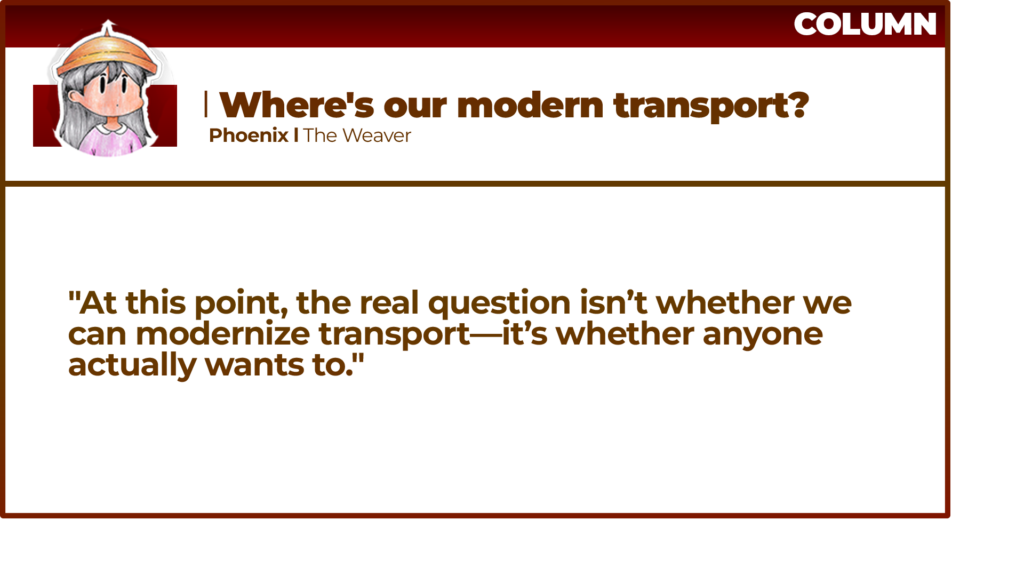
At this point, the real question isn’t whether we can modernize transport—it’s whether anyone actually wants to. If commuters continue to accept inefficiency as the norm, we are silently endorsing a system designed to profit from our pain. While Malampaya promises cheaper fuel and energy security, buses here will keep disappearing without warning, and we will keep waiting.
Share this website:




READ NEXT
COLUMN
by Phoenix l Published April 14, 2026
READ MORE
NEWS
by Phoenix l Published April 14, 2026
FEATURE
by Shell l Published April 14, 2026
SPORTS NEWS
by Petron l Published April 14, 2026